

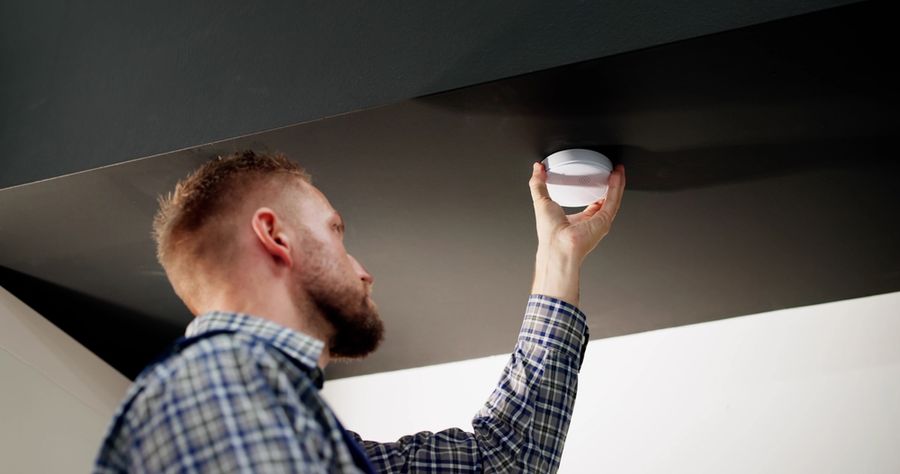
Most homeowners assume that as long as they have a few smoke and carbon monoxide detectors installed, they're protected. But location matters far more than people realize. A detector placed in the wrong spot can delay an alarm by critical minutes or fail to sense danger at all. Knowing exactly where to install each device and how high to mount it can be the difference between waking up in time and not waking up at all.
Start With the Basics: Every Level and Every Bedroom
The most important rule of detector placement is also the simplest. According to the National Fire Protection Association, smoke alarms should be installed inside every bedroom, outside each separate sleeping area, and on every level of your home, including the basement. Skipping any of these areas leaves a dangerous gap in coverage.
Carbon monoxide detectors follow a similar logic, but the rules differ slightly. The U.S. Consumer Product Safety Commission recommends installing a CO alarm outside each sleeping area and on every level of the home. If you can only afford one to start, the CPSC says to place it near the bedrooms so it can wake you while you sleep, when CO poisoning is most often fatal.
For maximum protection, choose interconnected models. When one alarm detects smoke or carbon monoxide, all of them sound, giving everyone in the home time to react no matter which floor they're on.
The Right Height for Smoke Alarms
Because smoke rises, smoke alarms work best when they are mounted as high in the room as possible. The NFPA recommends installing ceiling-mounted smoke alarms at least 4 inches away from the nearest wall to avoid the dead air space where the wall and ceiling meet. If you're mounting on a wall instead, the top of the alarm should sit between 4 and 12 inches below the ceiling.
Avoid placing smoke alarms in corners, in the path of supply vents, or directly above heat sources, all of which can interfere with how smoke reaches the sensor. If your home has vaulted or peaked ceilings, the alarm should be mounted on the sloped portion of the ceiling, but no closer than 4 inches and no farther than 36 inches from the highest point. Mounting at the very peak can actually trap smoke above the sensor and slow detection.
Why CO Detector Height Is Different Than You Think
A persistent myth is that carbon monoxide is heavier than air and should be detected near the floor. That isn't true. Carbon monoxide has a density very similar to air and mixes evenly throughout a room. That means CO detectors can be placed at almost any height and still work properly.
Many manufacturers recommend mounting CO detectors at about knee to chest height, especially in bedrooms, since that's closer to the breathing zone of someone lying down. Wall placement also keeps the device away from drafts and dust collection. That said, if you choose a combination smoke and CO alarm, mount it like a smoke alarm: on the ceiling or high on the wall. Always follow the specific instructions that come with your model, since the recommended height can vary slightly by product.
Keep Distance From Kitchens, Bathrooms, and Vents
False alarms are one of the most common reasons people disable detectors, which can be deadly. To minimize nuisance alarms, the NFPA recommends installing smoke alarms at least 10 feet away from cooking appliances. Steam from showers and humidity from bathrooms can also trigger sensors, so keep detectors at least 3 feet from bathroom doors as well.
Carbon monoxide alarms should sit at least 15 feet from fuel-burning appliances such as stoves, furnaces, water heaters, and fireplaces. Placing a CO detector too close can lead to constant false readings during normal operation and may delay response when there's a real leak.
Also, avoid placing any detector within 3 feet of ceiling fans, supply registers, windows, or exterior doors, since drafts can pull smoke or gas away from the sensor before it has a chance to register.
Sloped Ceilings, Tray Ceilings, and Other Tricky Spaces
Architectural details create some of the trickiest installation challenges. For tray or coffered ceilings, the NFPA states that smoke alarms should be installed on the highest portion of the ceiling, or on the sloped portion within 12 inches vertically of the highest point.
Stairwells need special attention, too. Smoke and heat travel up stairs quickly, so a smoke alarm should be installed at the top of every staircase leading to an occupied level. Avoid placing one at the bottom of the stairs, where smoke often passes by too quickly to trigger detection.
For finished basements, mount the alarm on the ceiling at the bottom of the stairs. For unfinished basements, place it on the bottom of the floor joists rather than between them, since smoke can become trapped in joist bays.
Test, Replace, and Stay Protected
Even perfectly placed detectors fail without regular maintenance. The NFPA recommends testing every alarm at least once a month and replacing batteries at least once a year unless your model uses a sealed 10-year battery. Smoke alarms should be replaced entirely every 10 years, while most carbon monoxide alarms should be replaced every 5 to 7 years, depending on the manufacturer.
A simple way to remember the schedule is to test detectors when you change the clocks for daylight saving time twice a year. Mark the installation date on the back of each unit so you know when it's due for replacement.
The right detector in the right place is one of the most affordable and effective safety upgrades any homeowner can make. Once your alarms are sorted, the next layer of preparedness is making sure you have the supplies you need before an emergency hits.